Americans are increasingly worried about retirement, and 40% say they aren’t confident they will have enough money to retire fully, or at all, according to Pew Research Center. Additionally, younger generations started saving at earlier ages, according to Northwestern Mutual.
However, older Americans report more positive retirement outcomes than younger Americans expect, according to Gallup.
On average, an American’s financial security and outlook increase with age, but this isn’t universal. And with changes to pensions, Social Security, and other benefits, retirement may look like an uncertain future.
These retirement statistics suggest that while many Americans do retire comfortably, some retirees rely on multiple income sources in retirement. This highlights the importance many households place on diversification and long-term planning.
Essential facts about retirement
The official Social Security retirement age in the U.S. has been steadily increasing, according to Social Security Administration. This means that American adults are working for longer, on average, before they can begin receiving Social Security benefits.
These are the most important facts to know about when you can retire:
1: 67 is the current full retirement age for Americans born after 1960. (Social Security Administration)
2: At age 62, Americans can begin to draw a reduced Social Security benefit. (Social Security Administration)
3: If Americans delay retirement past age 67, their monthly Social Security benefit will increase, depending on how long they wait. (Social Security Administration)
4: Generally, Americans can begin taking distributions from IRA or 401(k) accounts without penalties when they reach 59 and a half years old. (IRS)
5: Nearly half (45%) of American adults under 65 are not confident they will have enough to last their retirement years. (Pew Research Center)
Average retirement age in America
While the retirement age has risen in recent years, further increases seem unlikely, according to the Center for Retirement Research at Boston College.
Many Americans begin their retirement before their full Social Security benefits kick in. This is a positive sign because it means they have sufficient income from other sources to take a reduced distribution for a few years.
6: The average retirement age for men is 64.6. (Center for Retirement Research, Boston College)
7: The average retirement age for women in 2024 is 62.6. (Center for Retirement Research, Boston College)
8: There are many reasons for the steady rise in the retirement age, including the shift from pension plans to riskier 401(k) plans, changes to Social Security, fewer physically demanding jobs, rising health care costs, and other factors. (Center for Retirement Research, Boston College)
American concerns about retirement
Despite positive retirement signs, working-age Americans are increasingly worried about retirement. And the reduction in pension plans and concerns about Social Security continue to drive their worries. Social Security accounts for a meaningful portion of retirement income for many people, and potential future changes to the program could affect benefit levels for some retirees.
9: Retirement outcomes are often better than people believe: 53% of nonretired Americans expect to live comfortably, while 80% of retired Americans report living comfortably. (Gallup)
10: 77% of Americans feel that declining pensions make it more difficult to achieve the American dream. (National Institute on Retirement Security)
11: 79% of Americans believe there is a retirement crisis. (National Institute on Retirement Security)
12: 80% of American adults say they were worried or extremely worried about Social Security solvency. (Gallup)
13: In 2024, 73% of American adults said they were worried or extremely worried about Medicare solvency. (Gallup)
14: 87% of Americans believe that Social Security should remain a priority even during budget deficits. (National Institute on Retirement Security)
15: 87% of Americans are worried about increasing costs during retirement. (National Institute on Retirement Security)
16: 80% are worried about the rising costs of long-term care. (National Institute on Retirement Security)
17: 66% are concerned about rising healthcare costs during retirement. (National Institute on Retirement Security)
Retirement savings statistics
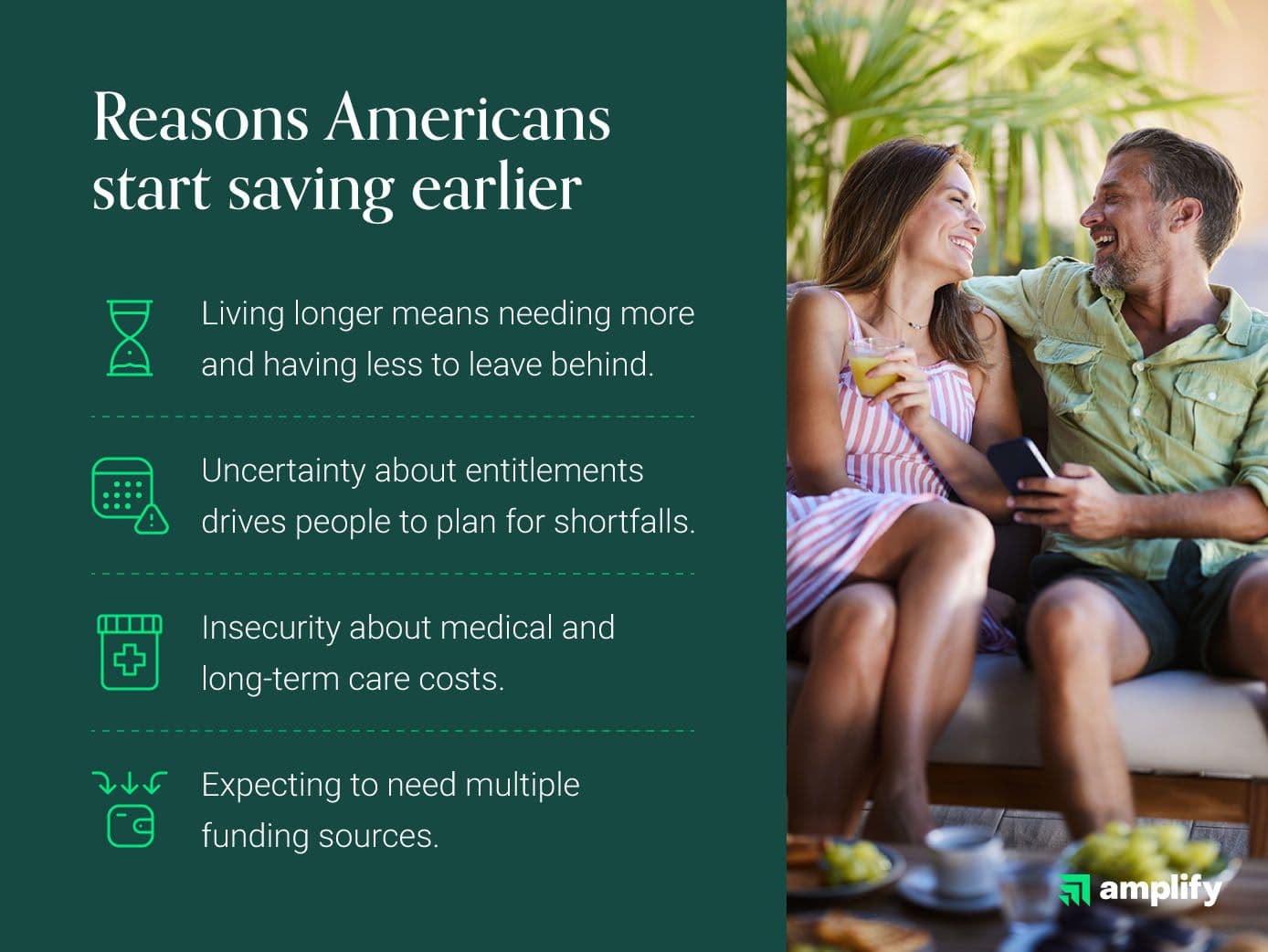
Data shows that Americans worry about and start saving for retirement earlier with each generation. This could be due to the changing retirement vehicles. 401(k) and IRA accounts are much more volatile than pensions, and we’re anxious that the benefits current retirees enjoy might not be there when it’s our turn.
18: American adults expect to need $1.26 million to retire comfortably. (Northwestern Mutual)
19: 54% of Gen X don’t believe they will be financially ready to retire. (Northwestern Mutual)
20: 51% of Americans think they may outlive their savings. (Northwestern Mutual)
21: Each generation begins saving earlier, with Gen Z starting retirement savings at 24. (Northwestern Mutual)
Some consumers also consider permanent life insurance policies, such as indexed universal life insurance, as a supplemental financial planning tool. These policies may include a cash value component that can grow over time based on a market index, subject to policy charges, caps, participation rates, and other limitations (cash value growth is not guaranteed). Using multiple financial vehicles may offer some households additional flexibility, depending on their individual circumstances.
22: Nearly two-thirds (59%) of Americans have a retirement savings account. (Gallup)
23: The average annual return on a 401(k) account is between 5% and 8%, but they are also subject to market fluctuations. (Farther)
24: In 2023, 24% of American workers had access to defined benefit pension plans. (Congress.gov)
25: Baby boomer investors have an average 401(k) balance of $249,300 and an average IRA of $257,002. (Fidelity)
26: Gen X investors have an average 401(k) balance of $192,300 and an average IRA balance of $103,952. (Fidelity)
27: Millennial investors have an average 401(k) balance of $67,300 and an average IRA balance of $25,109. (Fidelity)
28: Gen Z investors have an average 401(k) balance of $13,500 and an average IRA balance of $6,672. (Fidelity)
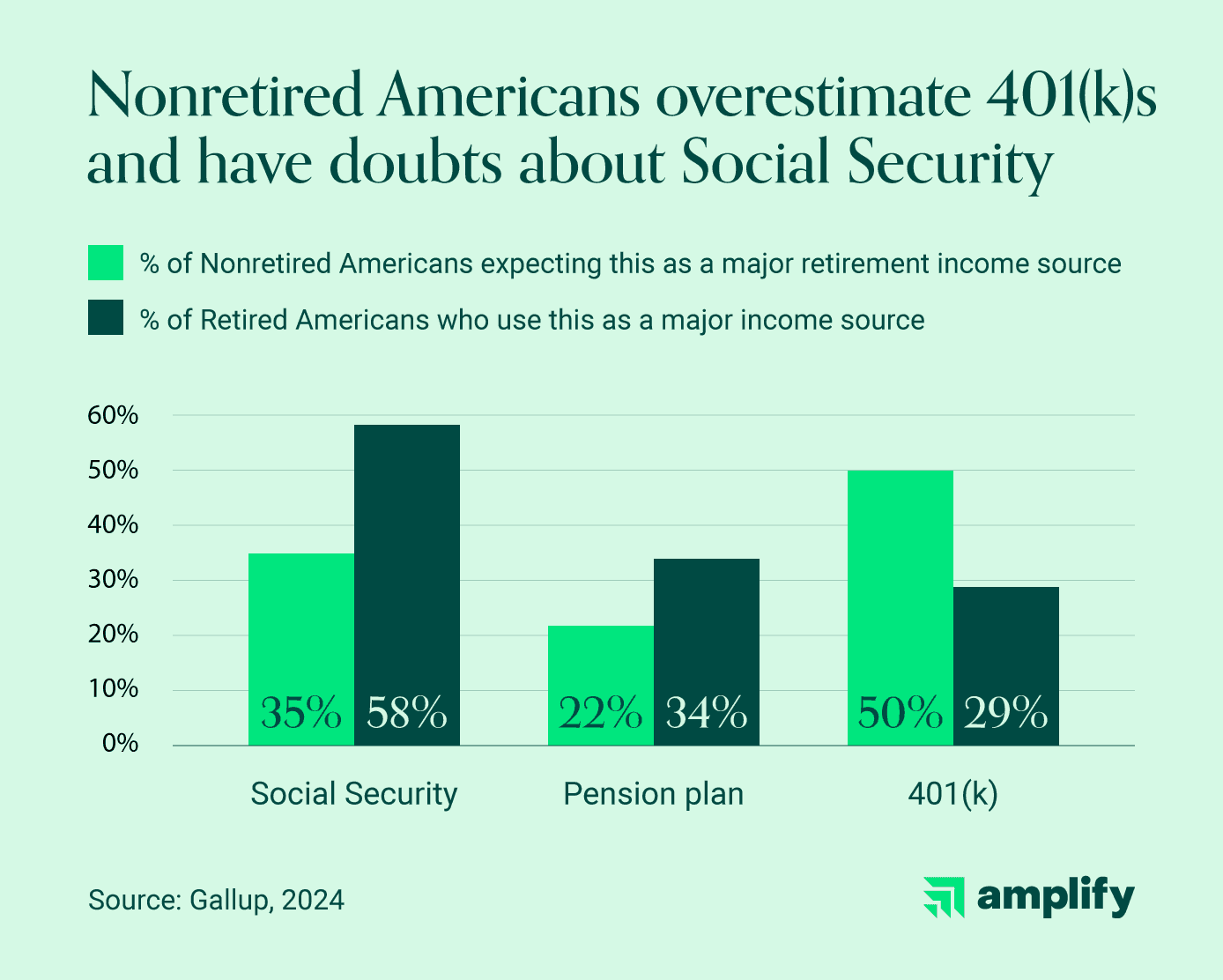
29: Americans overestimate the impact of 401(k) and IRA accounts: While 50% of non-retired Americans expect retirement savings accounts to be a major income source when they retire, 29% of retired Americans use them as a major income source. (Gallup)
Retirement income statistics
The ideal retirement income comes from multiple sources, including Social Security, savings accounts, assets, and other kinds of income. The earlier in life you build assets, the easier it is to retire comfortably.
If you need help estimating your retirement needs and benefits, the Social Security Administration has a handy calculator.
30: In 2022, half of American adults aged 65 and over had a total income of less than $29,740 per year. (Pension Rights Center)
31: The median retirement income for households aged 65+ is $56,680 per year. (Empower)
32: 50% of Americans with retirement savings accounts expect to have enough to live comfortably when they retire. (Gallup)
33: 31% of Americans without retirement savings accounts expect to have enough to live comfortably in retirement. (Gallup)
34: 94% of retired people with retirement savings plans report that they have enough to live comfortably. (Gallup)
35: 70% of retired people without retirement savings plans report that they have enough to live comfortably. (Gallup)
36: In 2022, the median private pension benefit for people 65 and older was $11,040 a year. (Pension Rights Center)
37: In 2022, the median state or local government pension benefit for people 65 and older was $24,980 a year. (Pension Rights Center)
38: In 2022, the median federal pension benefit for people 65 and older was $26,380 per year. (Pension Rights Center)
39: This puts the average pension payout per month at somewhere between $900 and $2,200 per month, depending on the sector and pension plan details.
Retirement preparedness demographics
While the retirement outlook does look positive for many Americans, as many as 1 in 4 don’t feel like they will be able to retire, and almost one-half of US households don’t have retirement savings. Retirement preparedness varies widely by demographic information such as income levels, gender, and race.
40: The older Americans get, the more confident they tend to become about money during retirement. (Pew Research Center)
41: 83% of Americans who make $100,000 or more per year have dedicated retirement savings accounts, compared to 28% who make less than $50,000 (Gallup)
42: 81% of college graduates have dedicated retirement savings accounts, compared to 39% of people with no college. (Gallup)
43: 61% of men have dedicated retirement savings accounts compared to 57% of women. (Gallup)
44: 42% of people of color have dedicated retirement savings accounts compared to 68% of non-Hispanic white people. (Gallup)
How to think about retirement differently
The good news is that many people are pleasantly surprised when they retire. The bad news is that it looks increasingly likely that people need multiple sources of income to make retirement work.
You don’t need to put all your eggs in one basket. Multiple savings plans with sensible risk management can carry you through retirement with a higher quality of life than you might expect.
Some permanent life insurance policies, such as IULs and VULs, offer tax-deferred cash value features that may be used as part of a broader financial strategy.
Multiple sources of savings can help by spreading your benefits out. With an IUL and other sources of savings, you can get additional financial protection so that life’s unexpected turns don’t interrupt retirement. Some people choose to coordinate different income sources in various ways, depending on eligibility rules and personal financial goals (for example, retiring early or delaying the commencement of Social Security benefits to increase the eventual monthly benefit).
Using cash value life insurance as part of a long-term financial strategy
If you’re stressed out by retirement plan news that casts doubts on Social Security or tells you that you need millions of dollars, remember that early action reaps long-term benefits.
People become, on average, more optimistic about retirement as they age, and many find themselves pleasantly surprised by their lives after retirement. The actions you take now build security into your future.
Some life insurance policies include a cash value component that may accumulate over time. Indexed Universal Life policies have a cash value portion that builds over time. An additional source of cash value may provide added flexibility in certain situations, depending on policy terms and performance..
Learn more about Indexed Universal Life insurance and discuss whether it may be appropriate for your individual needs.


![44 Retirement Statistics That May Influence How You Think About Your Current Plan [2026]](https://d1no9lxjyou7oz.cloudfront.net/retirement_statistics_hero_d7cb0f9a94.jpg)